Hey there! As a supplier of gas chromatographs, I often get asked about various aspects of these machines. One question that pops up quite frequently is, "What is the fronting factor in a gas chromatograph peak?" Well, let's dive right into it.
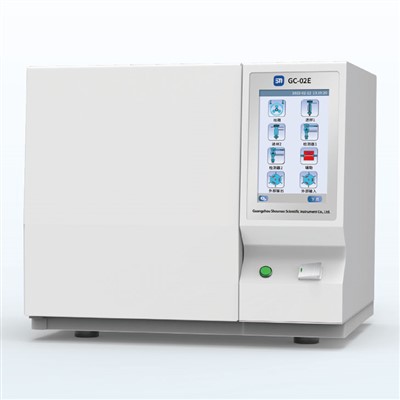
First off, let's understand what gas chromatography is all about. Gas chromatography is a powerful analytical technique used to separate and analyze volatile compounds in a sample. A gas chromatograph, like our GC - 06E Gas Chromatograph, GC - 02E Gas Chromatograph, and GC - 05E Gas Chromatograph, works by injecting a sample into a column, where the different components of the sample are separated based on their interactions with the stationary phase in the column.
Now, when we talk about a gas chromatograph peak, it represents the presence of a particular compound in the sample. The shape of the peak can tell us a lot about the separation process and the compound itself. A normal, well - behaved peak is usually symmetric, looking like a nice bell curve. But sometimes, we see peaks that are not symmetric. One such non - symmetric peak shape is fronting.
The fronting factor refers to the degree to which a peak is fronted. A fronted peak is one where the leading edge of the peak is steeper than the trailing edge. It kind of looks like the peak is leaning forward. This is in contrast to a tailing peak, where the trailing edge is steeper.
So, what causes fronting in a gas chromatograph peak? There are several factors at play here.


Overloading the Column
One of the most common reasons for peak fronting is overloading the column. When you inject too much of a sample into the column, the stationary phase in the column can't handle it properly. The column has a limited capacity to interact with the sample components. If you exceed this capacity, the excess sample components start to move through the column more quickly, causing the front of the peak to be steeper.
For example, let's say you're analyzing a mixture of volatile organic compounds. If you inject a large volume of the sample, the column gets swamped. The compounds that are supposed to be separated start to bunch up at the front of the peak, leading to fronting. To avoid this, it's important to optimize the sample injection volume. You can start by doing some trial runs with different injection volumes to find the sweet spot where the peaks are well - shaped.
Column Activity
The activity of the column can also contribute to peak fronting. The stationary phase in the column can have active sites that interact with the sample components. If these active sites are too reactive, they can cause the sample components to bind too strongly initially and then release in a non - uniform way. This can result in fronting.
Some columns may have impurities or residual active groups on the stationary phase. These can act as strong binding sites for the sample components. For instance, in a capillary column, if there are uncoated areas or areas with high surface energy, the sample components may interact with these areas in an abnormal way, leading to fronting. To deal with this, you can try using a deactivated column. A deactivated column has its active sites passivated, reducing the chances of strong interactions that cause fronting.
Sample Solvent Effects
The choice of sample solvent can also play a role in peak fronting. If the sample solvent has a different volatility or solubility characteristics compared to the mobile phase (the gas that carries the sample through the column), it can cause problems. For example, if the sample solvent is more volatile than the mobile phase, it can evaporate quickly in the column. This can lead to a sudden change in the local environment around the sample components, causing them to move through the column in an irregular way and resulting in fronting.
Let's say you're using a non - polar solvent to dissolve your sample, but the mobile phase is a polar gas. The difference in polarity can cause the sample components to behave differently in the column. To avoid this, it's a good idea to choose a sample solvent that is as similar as possible to the mobile phase in terms of volatility and polarity.
Interaction with the Injection Port
The injection port of the gas chromatograph can also be a culprit. If the injection port liner is dirty or has deposits, it can cause problems with the sample introduction. The sample may not be vaporized evenly in a dirty injection port liner. Some of the sample components may start to move through the column earlier than others, leading to fronting.
For example, if there are residues from previous injections in the liner, these residues can interact with the new sample. The sample components may adsorb onto the residues and then desorb in an inconsistent manner, affecting the peak shape. Regularly cleaning and replacing the injection port liner can help prevent this issue.
Temperature Effects
Temperature plays a crucial role in gas chromatography. If the column temperature is too low, the sample components may not have enough energy to move through the column freely. This can cause them to pile up at the front of the peak, resulting in fronting.
On the other hand, if the temperature is too high, the sample components may move through the column too quickly, but the separation may not be proper. The optimal temperature for a particular analysis depends on the nature of the sample and the column. You need to find the right temperature that allows for good separation and proper peak shape. For example, if you're analyzing high - boiling - point compounds, you may need to use a higher column temperature. But you have to be careful not to go too high, as it can lead to other problems like peak broadening or degradation of the sample.
Impact of Fronting on Analysis
Peak fronting can have a significant impact on the accuracy and precision of your analysis. When peaks are fronted, it becomes difficult to accurately measure the peak area and height. These measurements are crucial for quantifying the amount of a particular compound in the sample.
For example, if you're using peak area to calculate the concentration of a compound in a mixture, a fronted peak may give an inaccurate area measurement. This can lead to errors in your final results. Also, fronting can make it harder to separate closely eluting peaks. If two peaks are fronted, they may overlap more easily, making it difficult to distinguish between the two compounds.
How to Correct Fronting
To correct fronting, you need to address the root cause. As mentioned earlier, if it's due to overloading, reduce the sample injection volume. If it's a column activity issue, try using a deactivated column or conditioning the column properly. For sample solvent problems, change to a more appropriate solvent. And if the injection port is the problem, clean or replace the liner.
In conclusion, understanding the fronting factor in a gas chromatograph peak is essential for accurate and reliable analysis. As a gas chromatograph supplier, we offer a range of high - quality instruments like the GC - 06E Gas Chromatograph, GC - 02E Gas Chromatograph, and GC - 05E Gas Chromatograph that are designed to minimize these issues. But it's also important for you, the user, to be aware of the factors that can cause fronting and how to deal with them.
If you're facing problems with peak fronting or are looking to upgrade your gas chromatography setup, we're here to help. Our team of experts can provide you with advice on choosing the right instrument, optimizing your analysis parameters, and troubleshooting any issues you may encounter. Don't hesitate to reach out to us for a consultation and let's work together to get the best results from your gas chromatography analysis.
References
- Snyder, L. R., Kirkland, J. J., & Glajch, J. L. (1997). Practical HPLC Method Development. John Wiley & Sons.
- Poole, C. F. (2003). The Essence of Chromatography. Elsevier.
- McMaster, M. C. (2008). Gas Chromatography: A Practical User's Guide. Wiley - Interscience.