


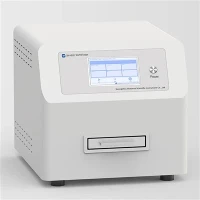


Thickness Gauge
Our goal is to become your true partner in the field of Electronic Thickness Gauge in China. Guangzhou Shounuo Scientific Instrument Co., LTD. founded in 2011, is a high-tech enterprise integrating research and development, production, sales and service of flexible packaging testing instruments. We have a skilled engineering team dedicated to refining every stage, from product development and process improvement to production oversight, ensuring every product delivered meets rigorous quality and performance standards. The price is competitive and the product is quality-assured, which is a good choice for your long-term cooperation.


Why Choose Us
Product application
Our products include electronic tensile testing machine, water vapor transmission rate tester, OTR tester, gas transmission rate tester, etc. These products are widely used in drug testing, quality inspection, colleges and universities, pharmaceutical packaging and other fields.
Production market
We use high-quality products and services to open up the international market. For many years, we have continued to provide high-quality products to overseas customers in dozens of countries and regions such as Europe, the United States, and Southeast Asia, and have been widely recognized by domestic and foreign customers.
Our services
In the pre-sales stage, our team of experts will recommend the most suitable products according to the needs of customers and provide detailed technical consultation. During the sales period, we ensure timely delivery and provide installation guidance. For after-sales, we provide long-term technical support, warranty services and spare parts to help customers maximize the use of products and get reliable maintenance during use.
Advantages of Electronic Thickness Gauge
Non-destructive testing (ndt)
Electronic thickness gauge is non-destructive, meaning it doesn’t damage or alter the material being tested. This is critical for components that cannot be physically altered during inspections, such as pressure vessels, pipelines, or safety-critical automotive parts.
Accuracy and precision
Electronic thickness gauges are known for their exceptional accuracy. These gauges provide precise measurements, often down to the millimeter, which is essential for industries where even the slightest variance can affect product quality or safety.
Ease of use
Our electronic thickness gauges are user-friendly, with clear digital displays and intuitive interfaces. Even with minimal training, operators can efficiently use these tools in the field or laboratory.
Versatility
Whether you are inspecting metal, composite materials, plastics, or ceramics, ultrasonic thickness gauges can handle a wide variety of materials, making them a versatile tool across industries like aerospace, automotive, and construction.

Electronic Thickness Gauge Specification
|
Item |
Technical Parameters |
|
Measuring range |
0~8mm |
|
Resolution |
0.1μm |
|
Sample distance |
0~100mm |
|
Measurement points |
0~50points (number adjustable) |
|
Measuring force |
0.5N |
|
Measuring head |
Φ5mm (customized) |
|
Operating temperature |
Temperature 23±2°C, humidity 55±20% RH |
|
Voltage |
AC 220V/50Hz |
|
Size |
350mm*300mm*380mm |
Types of Electronic Thickness Gauge
Dual-sensor thickness gauges: These gauges show both the coating and substrate together in one reading. They use two sensors to measure both the coating and base material at once. This helps get quick and accurate results when in the field.
Mechanical thickness gauges: A mechanical gauge uses a dial and needle. The needle moves as the plate presses against the material. It gives an analog reading. They are therefore slightly more accurate than the digital models.
Precision thickness gauges: A precision electronic thickness gauge is valuable in sectors where just a small variation can mess things up. They give very fine readings down to a few microns. Their accuracy is usually within a couple of microns.
Digital ultimate gauges: Users use a digital thickness gauge for coatings or surface treatments. These gauges show the coating thickness by measuring just the top layer of a material. They are ideal for painting, plating, and other surface tasks.
Ultrasonic thickness gauges: These gauges measure thickness without touching the material. They send sound waves through a substance and check how long it takes for the waves to bounce back. This lets the gauge measure how thick something is.
Features of Electronic Thickness Gauge
Integrated with a renowned imported pulse sensor, ensuring high accuracy and dependable performance, with a resolution as fine as 0.1μm. Compatible with both manual and automated testing modes.
Flexible measurement point adjustment, enabling single-point and multi-point testing. Capable of recording and saving 50 data sets (expandable upon request). Provides real-time updates on maximum, minimum, average, and current measurements. Features a 7-inch touchscreen with a smart, user-friendly interface designed for seamless operation.
Applications of Electronic Thickness Gauge
| Metal processing | Monitoring the thickness of rolled steel, aluminum, or copper sheets. |
| Plastics | Ensuring uniform thickness in extruded plastic films or molded parts. |
| Paper manufacturing | Controlling the thickness of paper or cardboard during production. |
| Glass production | Measuring the thickness of glass panels or bottles. |
| Coatings | Verifying the thickness of paint, adhesive, or protective coatings on surfaces. |
Packing and Shipping of Electronic Thickness Gauge
|
Packing |
Wooden box |
|
Shipping |
Shipped by road, sea, rail |