As a provider of Five - point Heat Sealers, I've witnessed firsthand the challenges and opportunities when it comes to sealing irregularly shaped items. In this blog post, I'll share some of the best practices and techniques to achieve optimal results when using our Five - point Heat Sealer for such items.
Understanding the Five - point Heat Sealer
Before delving into the sealing of irregularly shaped items, it's essential to understand the features and capabilities of our Five - point Heat Sealer. This innovative machine is designed with five heat - sealing points that can provide a strong and reliable seal. The five - point design allows for more even distribution of heat and pressure, which is crucial for creating a consistent seal across various materials.
The sealer is also equipped with advanced temperature control technology, enabling users to adjust the heat according to the specific requirements of the sealing material. This precision is vital when dealing with different types of plastics, films, and other packaging materials. Additionally, our Five - point Heat Sealer is known for its energy efficiency, making it a cost - effective solution for businesses of all sizes. You can learn more about our Energy - Efficient Sealer Machine on our website.
Challenges of Sealing Irregularly Shaped Items
Irregularly shaped items present unique challenges in the sealing process. Unlike regular rectangular or square packages, these items may have curves, protrusions, or uneven surfaces. This makes it difficult to apply consistent heat and pressure across the entire sealing area. If the heat and pressure are not evenly distributed, the seal may be weak in some areas, leading to leakage or poor product protection.
Another challenge is ensuring that the sealing material conforms to the shape of the item. Some irregularly shaped items may require special types of films or plastics that can stretch and mold around the contours. Selecting the wrong material can result in a loose or ineffective seal.
Best Ways to Seal Irregularly Shaped Items
1. Material Selection
The first step in sealing irregularly shaped items is choosing the right sealing material. For items with complex shapes, flexible films such as polyethylene or polypropylene are often a good choice. These materials can stretch and conform to the contours of the item, providing a tight seal.
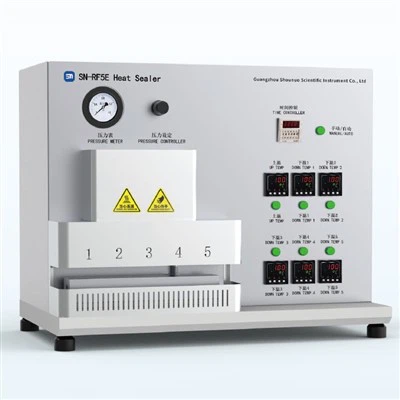
It's also important to consider the thickness of the material. Thicker films may be more durable but can be more difficult to seal, especially in areas with tight curves. Thinner films, on the other hand, may be easier to mold but may not provide as much protection. Our SN - RF5E 5 - Point Heat Sealing Tester can be used to test different materials and determine the optimal thickness and type for your specific application.
2. Pre - Shaping the Sealing Material
In some cases, pre - shaping the sealing material can help ensure a better seal. This can be done by using a mold or a heat - forming process to create a shape that closely matches the item. For example, if you are sealing a round object, you can pre - shape the film into a circular form before applying it to the item.


Pre - shaping can also help reduce the amount of stretching required during the sealing process, which can prevent the material from tearing or becoming too thin in some areas.
3. Adjusting the Heat and Pressure
Proper adjustment of the heat and pressure settings on the Five - point Heat Sealer is crucial for sealing irregularly shaped items. Since these items have uneven surfaces, it may be necessary to adjust the heat and pressure in different areas to ensure a consistent seal.
For example, if an item has a thick section and a thin section, you may need to increase the heat and pressure in the thick section to ensure proper melting and bonding of the sealing material. Our Five - point Heat Sealer allows for precise adjustment of these settings, giving you greater control over the sealing process.
4. Using Auxiliary Tools
In some cases, auxiliary tools can be used to assist in the sealing of irregularly shaped items. For example, a heat gun can be used to apply additional heat to areas that are difficult to reach with the sealer. This can help ensure that the sealing material is fully melted and bonded in these areas.
Another useful tool is a pressure pad. A pressure pad can be placed between the sealer and the item to help distribute the pressure more evenly. This is especially useful for items with uneven surfaces.
5. Testing and Quality Control
Before sealing a large batch of irregularly shaped items, it's important to conduct testing to ensure that the sealing process is working effectively. Our SN - RF5E 5 - Point Heat Sealing Tester can be used to test different sealing parameters, such as heat, pressure, and sealing time.
Quality control measures should also be implemented during the sealing process. This can include visual inspections to check for any signs of weak seals, such as gaps or uneven bonding. Additionally, leakage tests can be performed to ensure that the sealed items are airtight and watertight.
Conclusion
Sealing irregularly shaped items with a Five - point Heat Sealer requires careful planning, the right materials, and proper adjustment of the sealer settings. By following the best practices outlined in this blog post, you can achieve a strong and reliable seal for your irregularly shaped items.
If you are interested in learning more about our Five - point Heat Sealer or have any questions about sealing irregularly shaped items, please don't hesitate to contact us. We are always happy to assist you in finding the best sealing solution for your business needs. Whether you are a small - scale producer or a large - scale manufacturer, our Five - point Heat Sealer can provide you with the performance and reliability you need.
References
- Packaging Machinery Manufacturers Institute. (20XX). Guide to Heat Sealing Technology.
- Smith, J. (20XX). Advanced Packaging Materials and Their Applications.
- Jones, A. (20XX). Sealing Techniques for Irregularly Shaped Products.