Can a gas chromatograph be used for quantitative analysis? You bet it can! As a gas chromatograph supplier, I've seen firsthand how these nifty machines are not just for identifying compounds but are also rock - solid tools for quantitative analysis.
Let's start with the basics. Gas chromatography is a technique used to separate and analyze volatile compounds. A gas chromatograph consists of several key components: a sample injector, a column, a detector, and a data - handling system. When you're looking to perform quantitative analysis, each of these parts plays a crucial role.
The sample injector is where it all begins. You've got to get the right amount of your sample into the system. There are different types of injectors, like the split/splitless injector. For quantitative analysis, the splitless mode is often preferred because it allows you to introduce a larger and more representative sample into the column. This is super important as accurate quantification starts with getting the right amount of your target compounds into the machine.
Once the sample is in, it moves into the column. The column is like a long, winding maze where the different components of the sample separate based on their affinity for the stationary phase inside the column. The length, diameter, and the type of stationary phase all affect how well the separation occurs. For quantitative work, you want a column that provides good resolution between the peaks of your target compounds. That way, you can accurately measure the area or height of each peak, which is directly related to the amount of the compound in the sample.
Now, let's talk about the detector. There are various types of detectors available for gas chromatographs, such as the flame ionization detector (FID), thermal conductivity detector (TCD), and mass spectrometry detector (MSD). Each detector has its own strengths and limitations when it comes to quantitative analysis.
The FID is a very popular choice. It's highly sensitive to organic compounds and has a wide linear range. This means that it can accurately measure a large range of concentrations of your target compounds. The signal it produces is proportional to the amount of carbon atoms in the compound being detected. So, if you know how your compound responds to the FID, you can use the peak area or height to calculate the concentration of the compound in your sample.
The TCD, on the other hand, is a more universal detector. It can detect a wide range of compounds, including inorganic gases. It works based on the difference in thermal conductivity between the carrier gas and the sample components. While it's not as sensitive as the FID for organic compounds, it's great for quantitative analysis of gases like hydrogen, oxygen, and nitrogen.
The MSD is a powerful detector that not only provides quantitative information but also helps with compound identification. It can measure the mass - to - charge ratio of the ions produced from the sample components. By comparing the mass spectra of your sample peaks with a library of known spectra, you can identify the compounds. And for quantification, the peak areas in the mass chromatogram can be used to calculate the concentrations of the compounds, just like with other detectors.
One of the key methods for quantitative analysis using a gas chromatograph is the external standard method. In this method, you prepare a series of standard solutions with known concentrations of your target compound. You then inject these standards into the gas chromatograph and record the peak areas or heights. You create a calibration curve by plotting the peak areas or heights against the known concentrations. Once you have your calibration curve, you inject your unknown sample and measure the peak area or height of your target compound. You can then use the calibration curve to determine the concentration of the compound in your unknown sample.
Another method is the internal standard method. This method is useful when you have issues with sample injection reproducibility or when there are matrix effects. In the internal standard method, you add a known amount of a compound (the internal standard) to both your standards and your unknown samples. The internal standard should be similar to your target compound in terms of its chemical properties but not present in your sample. You then measure the ratio of the peak area or height of your target compound to that of the internal standard. By plotting these ratios against the known concentrations of your target compound in the standards, you can create a calibration curve. This method helps to correct for any variations in injection volume or other factors that could affect the accuracy of your quantification.
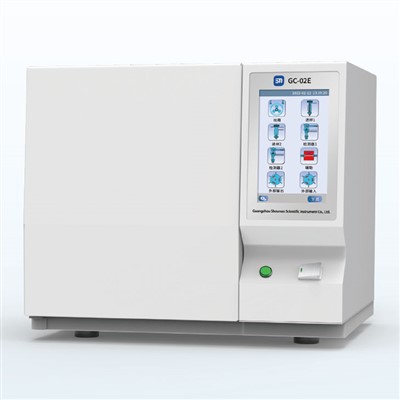
Now, let me tell you about some of the gas chromatographs we offer. Check out our GC - 02E Gas Chromatograph. It's a great option for both qualitative and quantitative analysis. It comes with a high - performance injector that ensures accurate sample introduction. The column oven is well - controlled, which is essential for consistent separation and quantification. And it's compatible with a variety of detectors, so you can choose the one that best suits your needs for quantitative work.
Our GC Analyzer is another top - notch product. It's designed with user - friendly software that makes it easy to set up your analysis and perform quantitative calculations. The detector in this analyzer has excellent sensitivity and linearity, which are key for accurate quantification. Whether you're analyzing environmental samples, food products, or petrochemicals, this GC Analyzer can handle it.
If you need a more advanced system, take a look at our GC - 06E Gas Chromatograph. It's equipped with state - of - the - art technology, which provides even better separation and more precise quantification. It has a high - speed data acquisition system that allows you to capture detailed information about your sample peaks, making it easier to accurately measure the peak areas or heights for quantitative analysis.
In conclusion, gas chromatographs are definitely capable of quantitative analysis. With the right choice of components, methods, and a reliable gas chromatograph like the ones we offer, you can achieve accurate and reproducible results. Whether you're a researcher in a lab, a quality control analyst in a manufacturing plant, or someone in the environmental field, a gas chromatograph can be an invaluable tool for your quantitative analysis needs.
If you're interested in learning more about our gas chromatographs or want to discuss your specific requirements for quantitative analysis, don't hesitate to reach out. We're here to assist you in finding the perfect solution for your analytical needs.


References
- McMaster, M. C. (2004). Gas chromatography: A practical approach. John Wiley & Sons.
- Snyder, L. R., Kirkland, J. J., & Glajch, J. L. (2010). Introduction to modern liquid chromatography. John Wiley & Sons.