

Can a gas chromatograph be connected to a mass spectrometer? This is a question that often arises in the fields of analytical chemistry and related scientific research. As a supplier of gas chromatographs, I am well - versed in this topic and will provide a comprehensive answer in this blog.
Understanding Gas Chromatographs and Mass Spectrometers
First, let's briefly introduce what gas chromatographs and mass spectrometers are. A gas chromatograph (GC) is an analytical instrument used to separate and analyze volatile compounds in a sample. It works by injecting a sample into a heated injector, where it is vaporized. The vaporized sample is then carried by an inert gas (the carrier gas) through a column packed with a stationary phase. Different components in the sample interact differently with the stationary phase, resulting in different retention times. As a result, the components are separated as they exit the column.
On the other hand, a mass spectrometer (MS) is an instrument that measures the mass - to - charge ratio (m/z) of ions. It ionizes the sample molecules, separates the ions according to their m/z values, and detects the abundance of each ion. Mass spectrometry provides valuable information about the molecular structure and identity of the compounds in a sample.
The Feasibility of Connecting a Gas Chromatograph to a Mass Spectrometer
The answer to whether a gas chromatograph can be connected to a mass spectrometer is a resounding yes. In fact, the combination of gas chromatography and mass spectrometry, known as gas chromatography - mass spectrometry (GC - MS), is a widely used and powerful analytical technique.
The connection between a GC and an MS is possible because the output of a gas chromatograph, which consists of separated volatile compounds, can be directly introduced into the ionization source of a mass spectrometer. The GC serves as a sample pre - separator, and the MS acts as a detector. This combination takes advantage of the separation power of GC and the identification capabilities of MS, providing a more comprehensive analysis of complex samples.
Advantages of GC - MS
There are several significant advantages to using a GC - MS system:
Enhanced Identification
One of the most important benefits is the ability to accurately identify compounds. While a gas chromatograph can separate compounds based on their retention times, it may not be sufficient to positively identify each component, especially in complex mixtures. Mass spectrometry, with its ability to provide detailed mass spectra, can be used to compare the obtained spectra with reference libraries, allowing for more confident compound identification.
Sensitivity
GC - MS systems are generally more sensitive than standalone gas chromatographs. The mass spectrometer can detect very low concentrations of compounds, making it suitable for trace analysis in various applications, such as environmental monitoring, drug testing, and food safety analysis.
Structural Information
Mass spectrometry provides valuable structural information about the compounds. By analyzing the fragmentation patterns in the mass spectra, chemists can deduce the molecular structure of the unknown compounds, which is crucial for understanding the chemical properties and behavior of the substances.
Our Gas Chromatographs for GC - MS Applications
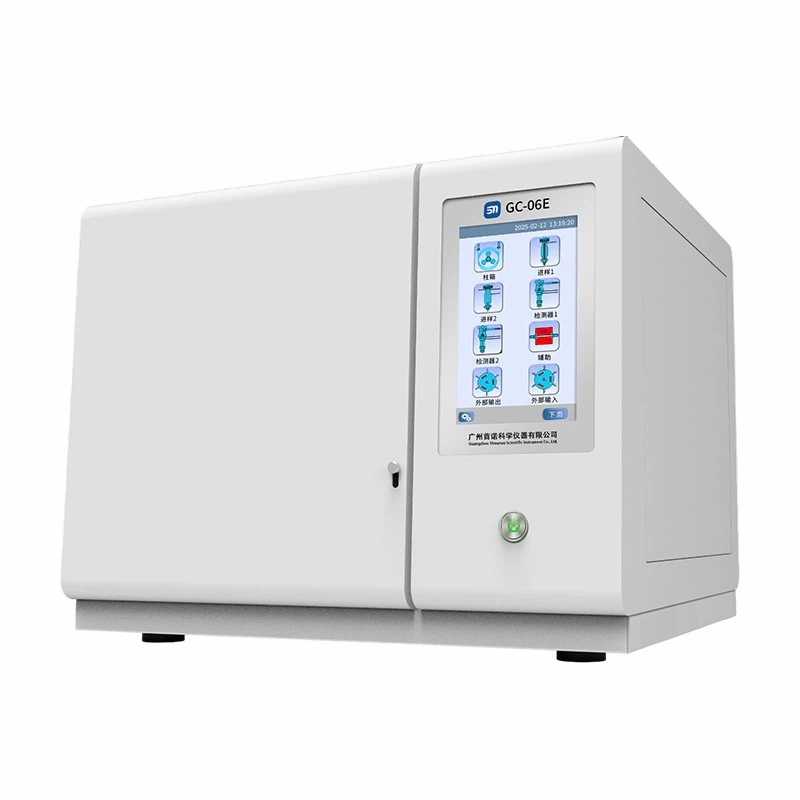
As a gas chromatograph supplier, we offer a range of high - quality products that are well - suited for connection to mass spectrometers. Our GC - 06E Gas Chromatograph is a state - of the - art instrument with excellent separation performance. It features advanced column technology and precise temperature control, ensuring accurate and reproducible separations. The GC - 06E can be easily interfaced with various mass spectrometers, providing a seamless transition for GC - MS analysis.
Another product in our lineup is the GC Analyzer. This analyzer is designed for both routine and complex analytical tasks. It has a user - friendly interface and a wide range of detection options, making it a versatile choice for laboratories. When connected to a mass spectrometer, the GC Analyzer can significantly enhance the analytical capabilities of the laboratory.
Our GC - 02E Gas Chromatograph is also a reliable option for GC - MS applications. It offers high - resolution separations and is compatible with different types of columns, allowing for customization according to the specific requirements of the analysis.
Technical Considerations for Connecting a GC to an MS
When connecting a gas chromatograph to a mass spectrometer, there are several technical considerations:
Interface Design
The interface between the GC and the MS is crucial. It needs to ensure that the separated compounds from the GC are efficiently transferred to the MS without significant loss or degradation. There are different types of interfaces available, such as the direct interface and the jet separator interface, each with its own advantages and limitations.
Vacuum Compatibility
Mass spectrometers operate under high - vacuum conditions. The gas chromatograph output, which contains the carrier gas and the separated compounds, needs to be introduced into the MS without disrupting the vacuum. Specialized vacuum pumps and valves are used to maintain the appropriate vacuum levels in the MS while allowing the sample to enter.
Data Acquisition and Analysis
The data acquisition and analysis software for the GC - MS system need to be integrated properly. The software should be able to handle the data from both the GC and the MS, allowing for simultaneous display and analysis of the chromatograms and mass spectra.
Applications of GC - MS
GC - MS has a wide range of applications in various industries:
Environmental Analysis
In environmental monitoring, GC - MS is used to detect and quantify pollutants in air, water, and soil samples. It can identify volatile organic compounds (VOCs), pesticides, and other contaminants, helping to assess environmental quality and ensure compliance with regulations.
Forensic Science
In forensic laboratories, GC - MS is a valuable tool for analyzing drug samples, arson residues, and other evidence. It can help identify the presence of drugs, accelerants, and other substances, providing crucial information for criminal investigations.
Food and Beverage Industry
GC - MS is used in the food and beverage industry to analyze flavors, aromas, and contaminants in food products. It can detect additives, pesticides, and spoilage compounds, ensuring the safety and quality of food and beverages.

Conclusion
In conclusion, a gas chromatograph can indeed be connected to a mass spectrometer, and the resulting GC - MS system offers numerous advantages in terms of compound identification, sensitivity, and structural analysis. As a gas chromatograph supplier, we are committed to providing high - quality products that are suitable for GC - MS applications. Our GC - 06E Gas Chromatograph, GC Analyzer, and GC - 02E Gas Chromatograph are designed to meet the diverse needs of laboratories in various industries.
If you are interested in purchasing a gas chromatograph for GC - MS applications or have any questions about our products, please feel free to contact us for further discussion and procurement negotiations. We look forward to working with you to enhance your analytical capabilities.
References
- McMaster, M. C. (2012). Gas Chromatography - Mass Spectrometry. Wiley - VCH.
- Miller, J. M. (2010). Chromatography: Concepts and Contrasts. Wiley.
- Sparkman, O. D., Penton, Z. A., & Kitagawa, G. (2011). Gas Chromatography and Mass Spectrometry: A Practical Guide. Academic Press.


