

In the realm of electronic systems, pendulums play a crucial role, especially in the context of impact testing and various scientific applications. As an electronic pendulum supplier, I have witnessed firsthand the distinct characteristics and applications of single - pendulum and double - pendulum electronic systems. This blog post aims to delve into the differences between these two types of systems, shedding light on their unique features, advantages, and ideal use cases.
Single - Pendulum Electronic System
The single - pendulum electronic system is a relatively straightforward yet highly effective mechanism. At its core, it consists of a single pendulum arm that swings from a fixed pivot point. This simplicity is both its strength and its limitation, depending on the application.
Structure and Operation
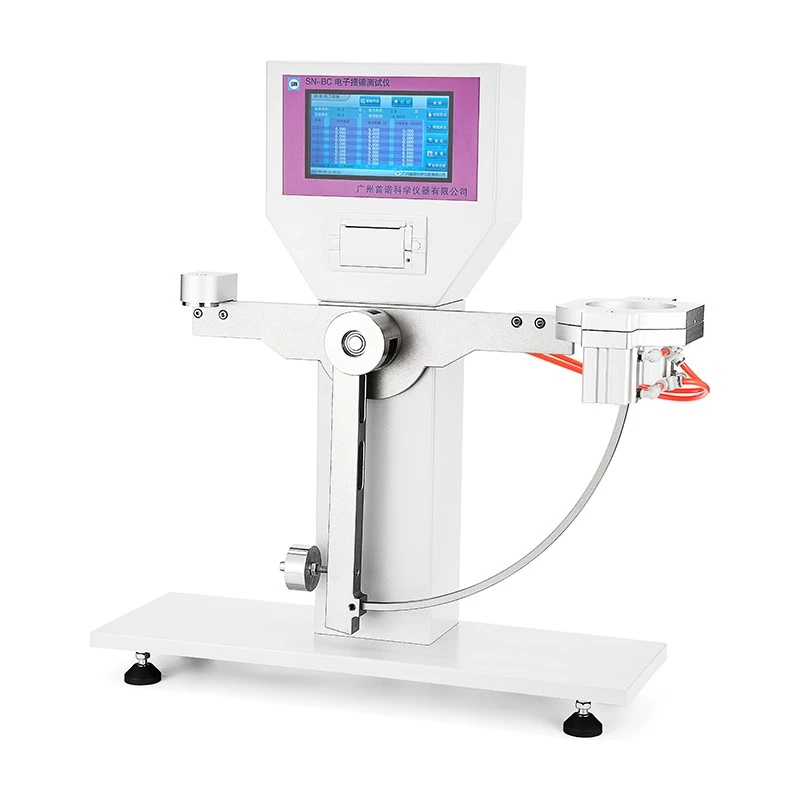
The single - pendulum system typically comprises a pendulum bob, which is attached to a rod or arm. The pivot point is where the arm is attached and allows for free rotation. When the pendulum is displaced from its equilibrium position and released, it swings back and forth under the influence of gravity. In an electronic version, sensors are integrated to measure various parameters such as the angle of displacement, the velocity of the pendulum at different points in its swing, and the time taken for each oscillation.
Applications
One of the most common applications of single - pendulum electronic systems is in impact testing. For instance, the SN - BC2E Electronic Pendulum Impact Tester utilizes a single - pendulum design. In this application, the pendulum is raised to a specific height and then released to strike a test specimen. By measuring the energy absorbed by the specimen during the impact, valuable information about its mechanical properties, such as toughness and brittleness, can be obtained. Single - pendulum systems are also used in educational settings to demonstrate the principles of physics, such as conservation of energy and simple harmonic motion.
Advantages
- Simplicity: The single - pendulum design is easy to understand and operate. This simplicity translates into lower costs for manufacturing, maintenance, and calibration.
- Predictability: The motion of a single pendulum is relatively easy to model and predict using well - established physical laws. This makes it ideal for applications where precise control and accurate measurements are required.
- Repeatability: Due to its simple structure, single - pendulum systems can achieve high levels of repeatability in their measurements. This is crucial in quality control and research applications where consistent results are essential.
Limitations
- Limited Complexity: The single - pendulum system can only provide a relatively simple type of motion. It may not be suitable for applications that require more complex dynamic behavior or multiple degrees of freedom.
- Less Real - World Representation: In some real - world scenarios, the behavior of objects is more complex than what can be accurately modeled by a single pendulum. For example, in the study of multi - body dynamics or in simulating the motion of complex structures, a single - pendulum system may not be sufficient.
Double - Pendulum Electronic System
The double - pendulum electronic system, on the other hand, is a more complex and fascinating mechanism. It consists of two pendulums connected in series, with the second pendulum attached to the end of the first one.
Structure and Operation
The double - pendulum system has two pivot points and two pendulum arms. The motion of the second pendulum is influenced not only by gravity but also by the motion of the first pendulum. This results in a highly complex and chaotic motion. In an electronic double - pendulum system, advanced sensors and control algorithms are used to measure and manage the motion of both pendulums. These sensors can detect the position, velocity, and acceleration of each pendulum at any given time.
Applications
Double - pendulum electronic systems are often used in advanced research and development, especially in the fields of chaos theory and nonlinear dynamics. They can also be used in the design and testing of complex mechanical systems, such as robotic arms and suspension systems. The ISO 179/ISO 180 Certified Impact Tester can be adapted to use a double - pendulum design in some specialized impact testing scenarios where more complex impact forces need to be simulated.
Advantages
- Complex Motion Simulation: The double - pendulum system can simulate a wide range of complex motions that are closer to real - world scenarios. This makes it valuable for research and development in areas where understanding complex dynamic behavior is crucial.
- Enhanced Impact Testing: In impact testing, a double - pendulum system can generate more complex impact forces, allowing for a more comprehensive evaluation of the mechanical properties of test specimens.
- Learning and Research: The chaotic nature of the double - pendulum motion provides an excellent platform for studying chaos theory and nonlinear dynamics. It can be used in educational institutions to teach students about these advanced concepts.
Limitations
- High Complexity: The design, operation, and analysis of double - pendulum electronic systems are significantly more complex than single - pendulum systems. This requires more advanced technical skills and resources, resulting in higher costs for development, maintenance, and calibration.
- Unpredictability: The chaotic nature of the double - pendulum motion makes it difficult to predict its behavior accurately. While this is an advantage in some research applications, it can be a drawback in applications where precise control and repeatability are required.
Comparison of Single - Pendulum and Double - Pendulum Electronic Systems
Motion Complexity
The most obvious difference between the two systems is the complexity of their motion. The single - pendulum system exhibits a simple, predictable, and periodic motion, while the double - pendulum system shows a highly complex and chaotic motion. This difference in motion complexity directly affects their suitability for different applications.

Cost
Single - pendulum electronic systems are generally more cost - effective than double - pendulum systems. The simplicity of the single - pendulum design reduces manufacturing costs, and the lower level of complexity also means lower maintenance and calibration costs. Double - pendulum systems, on the other hand, require more advanced components, sensors, and control algorithms, which drive up the overall cost.
Accuracy and Repeatability
Single - pendulum systems offer higher levels of accuracy and repeatability due to their simple and predictable motion. This makes them ideal for applications where precise measurements and consistent results are required, such as quality control in manufacturing. Double - pendulum systems, while capable of generating more complex and realistic motions, are less accurate and repeatable due to their chaotic nature.
Application Scope
Single - pendulum systems are widely used in standard impact testing, educational demonstrations, and applications where simplicity and predictability are key. Double - pendulum systems are more suitable for advanced research, development of complex mechanical systems, and specialized impact testing scenarios where more complex impact forces need to be simulated.
Conclusion
In conclusion, both single - pendulum and double - pendulum electronic systems have their unique features, advantages, and limitations. As an electronic pendulum supplier, I understand the importance of matching the right system to the specific needs of our customers. Whether you are looking for a simple and cost - effective solution for standard impact testing or a more complex system for advanced research and development, we have the expertise and products to meet your requirements.
If you are interested in learning more about our electronic pendulum systems or would like to discuss a potential purchase, please do not hesitate to contact us. Our team of experts is ready to assist you in making the right choice for your application. We look forward to the opportunity to work with you and provide you with high - quality electronic pendulum solutions.
References
- Goldstein, H., Poole, C. P., & Safko, J. L. (2002). Classical Mechanics (3rd ed.). Addison - Wesley.
- Strogatz, S. H. (1994). Nonlinear Dynamics and Chaos: With Applications to Physics, Biology, Chemistry, and Engineering. Addison - Wesley.


