

Can an Electronic Tensile Tester Test the Elastic Modulus of Materials?
In the realm of materials science and engineering, understanding the mechanical properties of materials is of utmost importance. One key property that engineers and researchers often seek to measure is the elastic modulus, also known as Young's modulus. This parameter provides valuable insights into a material's stiffness and its ability to deform elastically under an applied load. But can an electronic tensile tester be used to test the elastic modulus of materials? The answer is a resounding yes, and in this blog, we'll explore how.
As a leading supplier of electronic tensile testers, we have witnessed firsthand the crucial role these instruments play in accurately determining the elastic modulus of various materials. Our range of high - quality testers, including the SN - DE Electronic Tensile Tester, SN - 1E Electronic Tensile Tester, and SN - 2SE Electronic Tensile Tester, are designed to provide precise and reliable results for a wide array of materials.
Understanding the Elastic Modulus
The elastic modulus is defined as the ratio of stress to strain within the elastic region of a material's stress - strain curve. Stress is the force applied per unit area, while strain is the measure of deformation of the material. Mathematically, it is expressed as (E=\frac{\sigma}{\epsilon}), where (E) is the elastic modulus, (\sigma) is the stress, and (\epsilon) is the strain.
In simple terms, a high elastic modulus indicates that a material is stiff and requires a large amount of force to cause a small amount of deformation. Conversely, a low elastic modulus means the material is more flexible and can be easily deformed under a relatively small load.
How Electronic Tensile Testers Work
An electronic tensile tester is a sophisticated instrument that applies a controlled tensile force to a material specimen until it breaks. During the test, the tester measures the force applied and the corresponding deformation of the specimen. This data is then used to generate a stress - strain curve, from which the elastic modulus can be determined.
The tester consists of a load cell, which measures the force applied to the specimen, and an extensometer, which measures the deformation. The load cell converts the force into an electrical signal, which is then processed by the tester's control system. The extensometer, on the other hand, provides accurate measurements of the specimen's elongation.
Testing the Elastic Modulus with an Electronic Tensile Tester
To test the elastic modulus of a material using an electronic tensile tester, the following steps are typically followed:
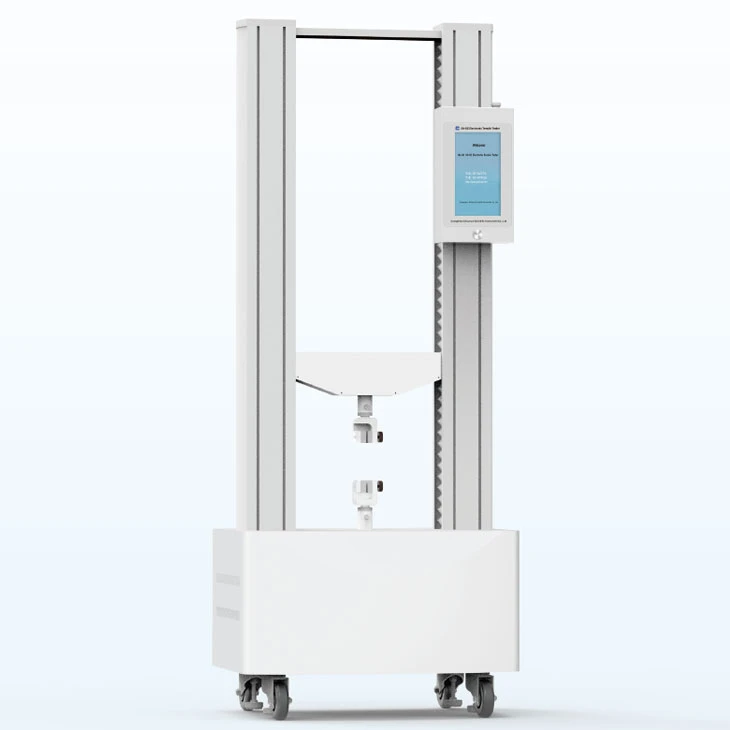

- Specimen Preparation: A specimen of the material is prepared according to the relevant standards. The specimen should have a specific shape and dimensions to ensure accurate results. For example, in the case of metals, a dog - bone shaped specimen is commonly used.
- Mounting the Specimen: The specimen is carefully mounted between the grips of the tensile tester. The grips should be adjusted to ensure a secure hold on the specimen without causing any damage.
- Initial Setup: The tester is calibrated to ensure accurate force and deformation measurements. The extensometer is attached to the specimen to measure the deformation during the test.
- Testing: The tester applies a gradually increasing tensile force to the specimen at a constant rate. The force and deformation data are recorded continuously during the test.
- Data Analysis: Once the test is complete, the stress - strain curve is generated from the recorded data. The elastic modulus is then calculated from the linear portion of the stress - strain curve, where the material behaves elastically.
Advantages of Using an Electronic Tensile Tester for Elastic Modulus Testing
There are several advantages to using an electronic tensile tester for testing the elastic modulus of materials:
- Accuracy: Electronic tensile testers are highly accurate, providing precise measurements of force and deformation. This ensures that the calculated elastic modulus is reliable and can be used for material characterization and design purposes.
- Repeatability: The tests can be easily repeated to ensure consistency of results. This is important for quality control and research applications, where accurate and reproducible data is essential.
- Versatility: Electronic tensile testers can be used to test a wide range of materials, including metals, polymers, composites, and ceramics. This makes them a valuable tool for various industries, such as automotive, aerospace, and construction.
- Automation: Many modern electronic tensile testers are equipped with advanced control systems that allow for automated testing. This reduces the potential for human error and increases the efficiency of the testing process.
Applications of Elastic Modulus Testing
The measurement of the elastic modulus has numerous applications in various industries:
- Material Selection: Engineers use the elastic modulus to select the most suitable materials for a particular application. For example, in the aerospace industry, materials with high elastic moduli are preferred for structural components to ensure stiffness and strength.
- Quality Control: Elastic modulus testing is an important part of quality control in manufacturing processes. By ensuring that the elastic modulus of a material meets the specified requirements, manufacturers can guarantee the quality and performance of their products.
- Research and Development: Researchers use elastic modulus testing to study the behavior of new materials and to develop new manufacturing processes. This helps in the development of innovative materials with improved properties.
Conclusion
In conclusion, an electronic tensile tester is a powerful tool for testing the elastic modulus of materials. It provides accurate, reliable, and repeatable results, making it an essential instrument in materials science and engineering. As a supplier of electronic tensile testers, we are committed to providing our customers with high - quality instruments that meet their testing needs.
If you are interested in purchasing an electronic tensile tester for elastic modulus testing or have any questions about our products, we encourage you to contact us for a detailed discussion. Our team of experts is ready to assist you in finding the right solution for your specific requirements.
References
- Callister, W. D., & Rethwisch, D. G. (2011). Materials Science and Engineering: An Introduction. Wiley.
- ASTM International. (2019). Standard Test Methods for Tension Testing of Metallic Materials. ASTM E8/E8M - 19.
- ISO. (2019). ISO 6892 - 1:2019 Metallic materials — Tensile testing — Part 1: Method of test at room temperature.


